Industry News • 28 Oct, 2026 • 11 min read
Nigeria's Transportation & Logistics Sector
By Andrea Davila
Nigeria’s transportation and logistics sector connects producers, importers, exporters, and consumers across the country and the wider West African region. Ports, roads, railways, airports, inland waterways, warehouses, and freight services all contribute to the movement of goods. As Nigeria’s economy and trade links evolve, the efficiency of these networks has a direct impact on business costs, delivery schedules, and supply-chain reliability.
Why logistics efficiency matters
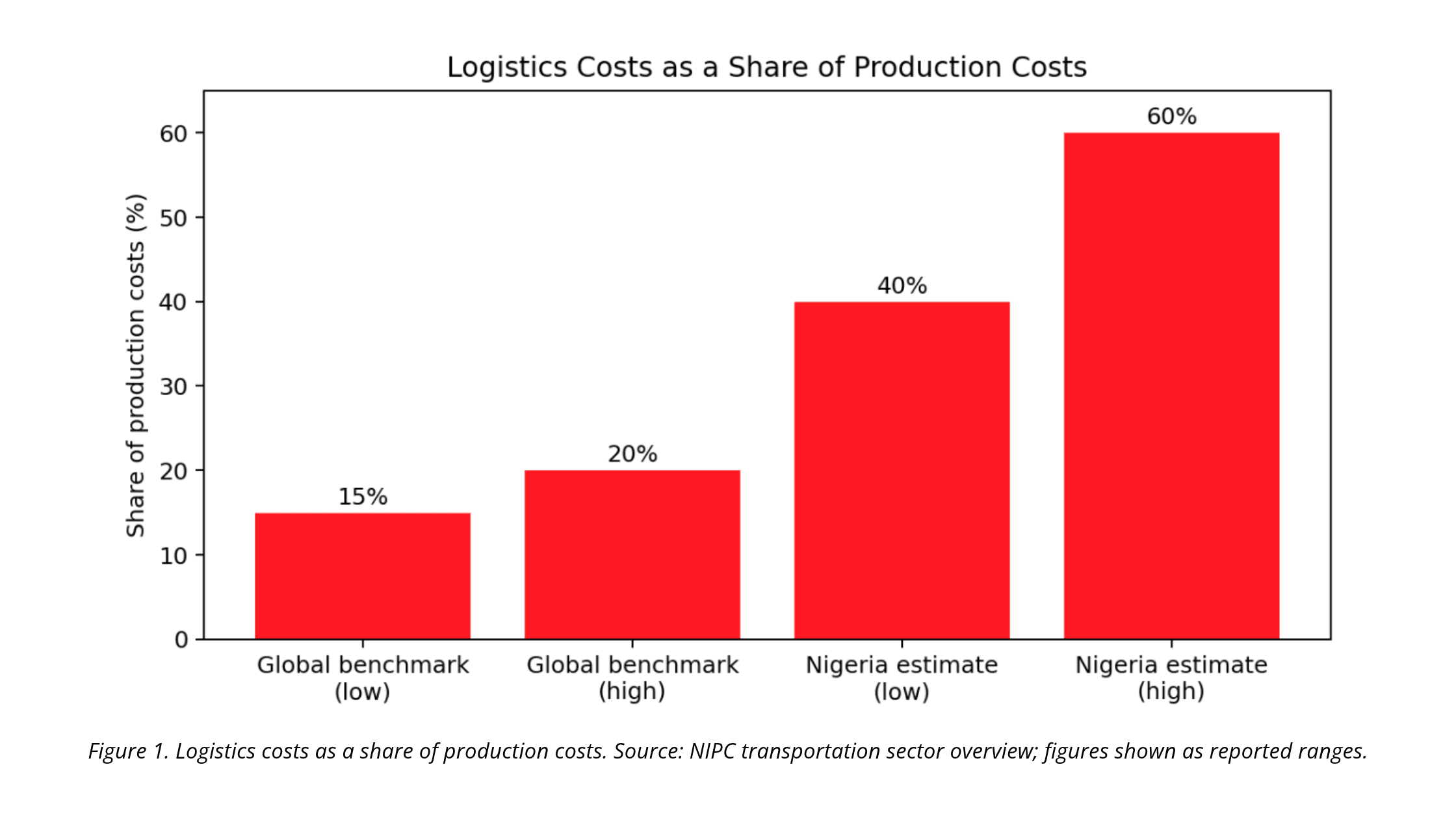
The Nigerian Investment Promotion Commission (NIPC) transportation sector overview highlights infrastructure needs and investment opportunities across the sector. One widely cited estimate in the overview is that logistics costs can represent 40–60% of production costs in some Nigerian sectors, compared with a global benchmark of 15–20%. These figures should be treated as broad estimates: actual costs vary by industry, shipment type, distance, fuel prices, handling requirements, and customs processes.
Port activity and cargo movement
Ports are a central part of Nigeria’s international supply chain, handling imported goods, export cargo, containers, and project-related equipment. Reported maritime-sector figures indicate that Nigerian ports handled more than 129.3 million metric tonnes of cargo in 2025, compared with approximately 103.6 million tonnes in 2024—an increase of about 24.8%, or 25.7 million tonnes. This reported growth suggests expanding cargo activity, although throughput alone does not indicate whether congestion, clearance times, or transport costs have improved.
A road-dependent transport system
Road transport remains especially important to domestic freight movement and to the first- and last-mile legs that connect ports, warehouses, industrial sites, and customers. NIPC cites a national road network of approximately 195,000 kilometres. However, network size alone does not describe road quality or accessibility; congestion, road conditions, fuel costs, security, and vehicle availability can all influence the reliability of freight movement.
A 2025 sectoral breakdown reported by the Development Bank of Nigeria, based on National Bureau of Statistics data, attributes approximately 75.15% of transport and storage sector output to road transport. The remaining shares were reported as water transport (8.97%), post and courier (7.05%), air transport (5.96%), other transport services (2.84%), and rail and pipelines (0.03%). These are shares of sector output—not shares of cargo tonnage or shipment volume
Infrastructure investment and port efficiency
The NIPC transportation overview cites a potential allocation of $575 billion for transportation infrastructure through 2043 under Nigeria’s National Integrated Infrastructure Master Plan. This is a long-term planning figure, not a statement that the full amount has already been spent or committed.
Port efficiency is another important part of supply-chain performance. A World Trade Organization review, citing Nigerian authorities, reported that container dwell times at Nigerian ports had decreased from roughly 22–25 days in 2017 to around 14 days in 2023. Dwell time refers to how long a container remains at the port; actual times can vary by terminal, cargo, documentation, inspections, and clearance requirements.
Other reported indicators help illustrate the scale and variation of port activity. Nigerian ports handled about 1.57 million twenty-foot equivalent units (TEUs) in 2023. Separate reporting on Lagos seaports indicated 2024 imports of approximately 10.23 million metric tonnes and exports of about 661,547 metric tonnes. The Lagos figures refer to Lagos seaports, not every port in Nigeria, and should be checked against the latest official release before publication.
Key opportunities in Nigeria’s logistics industry
- Port infrastructure and cargo handling: Investments in terminals, handling equipment, inland container depots, and more efficient cargo processes can support smoother movement between ships and inland destinations.
- Warehousing and inventory management: Warehousing, short-term storage, consolidation, and inventory visibility can help importers and exporters manage shipment timing and avoid unnecessary handling.
- Freight forwarding and customs coordination: Accurate documentation, customs clearance coordination, and communication between shippers, carriers, and consignees can reduce preventable delays.
- Road and multimodal connections: Reliable trucking and stronger connections among ports, warehouses, rail, and inland waterways can widen transport options and improve distribution.
- Digital logistics tools: Shipment tracking, digital documentation, freight planning, and inventory systems can improve visibility and help businesses respond to disruptions.
What this means for businesses trading with Nigeria
For businesses importing or exporting through Nigeria, transportation efficiency affects total landed cost, delivery timelines, inventory planning, and customer experience. The figures above point to three practical priorities: plan for the full shipment journey, ensure documentation is complete before cargo moves, and coordinate freight, storage, and delivery requirements early.
For shipments between the United States and Nigeria, a logistics partner can help coordinate freight forwarding, cargo consolidation, warehousing, export documentation, and customs-clearance arrangements with the relevant parties. The right service plan depends on cargo dimensions and weight, commodity type, origin and destination, delivery requirements, and whether air or ocean freight is the better fit.
Which industries and products are most traded in Nigeria?
Nigeria’s international goods trade is heavily influenced by petroleum, but imports show a broader mix of manufactured goods, fuels, machinery, food products, and industrial inputs. The National Bureau of Statistics’ Q4 2025 trade figures show that manufactured goods made up the largest broad category of imports, while crude oil remained the leading export category. This difference matters for logistics providers because import and export supply chains often require different cargo handling, documentation, storage, and transport arrangements.
Q4 2025 trade by sector
In the fourth quarter of 2025, Nigeria’s total goods trade was approximately ₦36.2 trillion: exports were about ₦18.96 trillion and imports were about ₦17.25 trillion. Manufactured goods imports were valued at roughly ₦8.80 trillion (about 51% of imports), followed by other petroleum products at ₦4.02 trillion. On the export side, crude oil was valued at about ₦9.70 trillion (about 51% of exports), followed by other petroleum products at ₦6.12 trillion.
Major export industries and products
- Crude oil and petroleum products: The leading export group. In Q4 2025, crude oil accounted for about ₦9.70 trillion, while other petroleum products contributed approximately ₦6.12 trillion.
- Natural gas and other energy products: Natural gas, petroleum gases, and jet fuel are among Nigeria’s major exported products and require cargo-specific handling and documentation.
- Agriculture and food-related commodities: Cocoa and other agricultural products contribute to non-oil exports, with export volumes and values varying by quarter.
- Raw materials and manufactured goods: These categories are smaller than petroleum in export value but are important to diversification and industrial supply chains.
Major import industries and products
- Manufactured goods: The largest broad import category in Q4 2025, valued at approximately ₦8.80 trillion. This category covers a wide range of finished and semi-finished goods.
- Petroleum products and fuels: Despite being a major oil producer, Nigeria also imports refined petroleum products and other fuels.
- Machinery and transport equipment: Industrial machinery, electrical equipment, vehicles, and related components support manufacturing, construction, energy, and consumer markets.
- Agricultural and food products: Wheat, sugar, and other food commodities appear among leading imported products, reflecting demand from households and food-processing industries.
- Raw materials and plastics: Industrial inputs support local manufacturing and may move through supply chains involving container freight, warehousing, and customs clearance.
What these trade patterns mean for logistics
The trade mix creates demand for several types of logistics services. Manufactured imports may need container shipping, customs coordination, warehousing, and distribution. Machinery and industrial equipment can require careful packing, project-cargo planning, or specialized handling. Agricultural products may have seasonal schedules and commodity-specific documentation, while petroleum and gas cargoes require specialized infrastructure and compliance.
For a freight forwarder serving the United States–Nigeria lane, the practical opportunity is to support suitable non-liquid cargo such as machinery, equipment, commercial goods, and industrial supplies with coordinated freight, consolidation, storage, and export documentation. Cargo type, dimensions, weight, regulatory requirements, and destination handling capacity should be confirmed before quoting or accepting a shipment.
Conclusion
Nigeria’s transportation sector combines significant cargo activity with ongoing infrastructure and efficiency challenges. Reported port throughput growth, the importance of road transport, and long-term infrastructure plans all point to a large and evolving logistics market. For shippers and supply-chain teams, reliable coordination and careful planning remain essential to controlling costs and moving cargo efficiently.
Related Blog Posts