
Industry News • 5 May, 2026 • 3 min read
Why Texas Continues to Lead the U.S. Freight and Logistics Industry
By Andrea Davila
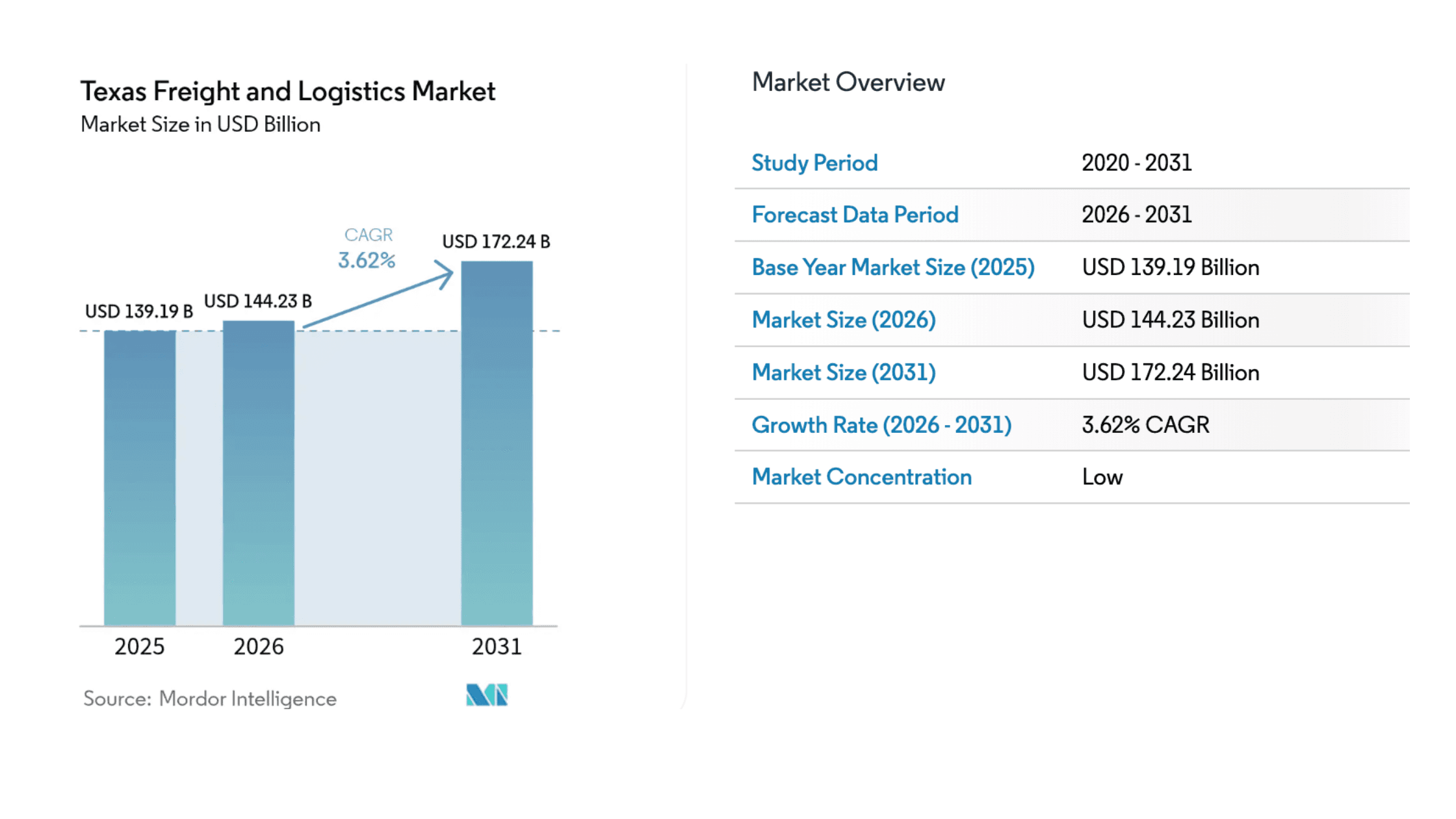
Texas continues to be one of the most critical freight and logistics hubs in North America. With a market valued at over $140 billion in 2026 and steady growth projected through the decade, the state’s logistics network is expanding in both scale and operational complexity.
Houston Port Growth
Behind this growth is Port Houston, one of the most powerful economic engines in the country. The Houston Ship Channel, supported by more than 200 private and public terminals, ranks as the largest U.S. port for waterborne tonnage. In 2023 alone, it handled over 309 million tons of cargo, reinforcing its dominance in bulk and industrial freight. It supports over 1.5 million jobs across Texas and contributes more than $439 billion in statewide economic value, making it a cornerstone of both regional and national supply chains.
In 2025, Port Houston handled more than 54 million tons of cargo across its public terminals, alongside a record 4.3 million TEUs in container volume, reflecting consistent growth despite global trade volatility. This performance stems from its cargo mix, including petrochemicals, manufacturing goods, and consumer imports.
Geographically, Texas is a primary gateway for U.S.–Mexico trade. As nearshoring accelerates, freight volumes are increasingly flowing through key corridors like I-35 and major border crossings, reinforcing the state’s role in cross-border logistics.
Transportation continues to anchor the industry, with trucking dominating due to its flexibility and essential role in last-mile delivery. At the same time, air freight is gaining traction as demand grows for faster, high-value shipments.
Beyond Trade
Warehousing across Texas is scaling up with automation, improved inventory systems, and specialized storage solutions to handle increasing throughput and more complex distribution requirements, especially as e-commerce and industrial demand continue to rise.
Still, growth brings operational pressure. Infrastructure constraints, from congestion along major corridors to capacity limitations at ports and rail hubs, remain ongoing challenges. Even so, continued investment and strong demand are keeping the market on an upward trajectory.
Ultimately, Texas continues to expand its logistics footprint and North American trade positioning. With the scale of Port Houston and continued industrial growth across the state, Texas is set to remain a central force in how freight moves for years to come.
Related Blog Posts
![[object Object]](/_next/image?url=https%3A%2F%2Fcdn.sanity.io%2Fimages%2Fj6rggeis%2Fproduction%2Fb3480cb82a8dbec162e8cb7bae51ad8e8b6fa2e7-2240x1260.jpg&w=3840&q=75)
![[object Object]](/_next/image?url=https%3A%2F%2Fcdn.sanity.io%2Fimages%2Fj6rggeis%2Fproduction%2F7ad625a0410e359fd61ef0773f77e1800b510c03-2240x1260.png&w=3840&q=75)
![[object Object]](/_next/image?url=https%3A%2F%2Fcdn.sanity.io%2Fimages%2Fj6rggeis%2Fproduction%2F4d41da7b56424c35af0d33fe2194588ac02959a3-2240x1260.png&w=3840&q=75)
![[object Object]](/_next/image?url=https%3A%2F%2Fcdn.sanity.io%2Fimages%2Fj6rggeis%2Fproduction%2F66a515608ad34ea382b2934ebe15810e650d41b6-2240x1260.png&w=3840&q=75)